

I got into a two-day workshop in Charleston, SC. It only happens once a year in the US, so my partner and I booked around it: flights, hotel, rental car. What I didn’t have was a plan for the time that wasn’t already spoken for.
My usual process is sprawl: a Notion doc, a Google Maps list, a handful of tabs I forget to close, a notes app that never gets finished. I decided to try something different and work through it in a Friday conversation instead. Partly as a test, and partly because I was tired of maintaining five separate places for one trip.
Here’s the full conversation, step by step.
1. The first message had nothing to do with planning
I had the city and the weekend, but I was blanking on the workshop venue name. So I asked Friday to track it down.
Me: We’re attending a two-day workshop in Charleston, SC next weekend. I know the general area but I’m drawing a blank on the venue name and organizer. Can you find it?
Friday: Found it. Venue confirmed, about 25 min from downtown. Only US workshop this year. Want me to save this and start building out the trip?
It took one search. The address also turned out to matter for everything downstream. Knowing the venue was 25 minutes from downtown shaped what made sense to do on workshop evenings.
2. Dropping in the logistics
Next I shared my flight, hotel, and rental car confirmations as images and asked for help building an itinerary.
Me: Going to Charleston May 22–25. Flights, hotel, and rental car are all booked. I’ll share the details as images. Help me build an itinerary around the workshop.
Friday read the confirmations, created a workspace for the trip, saved everything to memory, and confirmed it was ready in a single response. It felt like setting up a project folder, except I didn’t touch anything.
The trip had a home, centralized in one place, not five. Every piece of research and every decision from here on lived there.
3. Research with real constraints
I asked for food options: Friday dinner, breakfasts Saturday through Monday, lunch on Monday. I gave it two constraints no seafood, and breakfasts should be light, like a good SF bakery.
Me: Looking for food for Friday night, breakfasts sat/sun/mon, and lunch on Monday. For breakfasts something light, bakery/coffee shop, think like Tartine or similar. No seafood. Vegetarian-friendly options are a plus.
Friday: Researching all of these in parallel. A few things worth flagging: Welton’s Tiny Bakeshop — best pastries in Charleston, opens 8am Sat/Sun/Mon, but sells out early. Go first thing. WildFlour Pastry — great option Sat/Sun, but closed Monday. Worth knowing before you plan around it. For Friday dinner, all four shortlist options work for vegetarian. Ma’am Saab (Pakistani) and Basic Kitchen (veggie-forward American) are the strongest fits.
WildFlour being closed Monday is the kind of thing you find by clicking through to the restaurant’s site. Friday flagged it upfront because it affected the plan. Same with Welton’s selling out early. A search for “Charleston bakery” returns a ranked list. This returned a filtered one with the gotchas already called out.
The constraints that shaped the research:
Dietary — No fish. Vegetarian-friendly preferred across all meals.
Monday cutoff — Car dropoff at 2pm. Lunch had to be en route to the airport.
Workshop evenings — Venue is 25 min from the hotel. Dinner with the group both nights, no solo planning needed.
Proximity — Hotel is 5 min from Charles Towne Landing. Used to anchor Monday morning.
None of these required a separate pass. They accumulated across the conversation and stayed live throughout.
4. Monday morning
Saturday and Sunday were full with the workshop. Friday evening was arrival and dinner. That left Monday morning before checkout. I asked for nature options.
Me: Let’s figure out something to do in Charleston or nearby on Monday morning. Nature stuff is always fun.
Friday: The logistics work in your favor. Your hotel is right next to two good ones: Charles Towne Landing State Historic Site — 5 min from your hotel. Live oak alley, marsh trails, Ashley River views. Opens 9am, $12/adult, no booking needed. Magnolia Plantation (Audubon Swamp Garden) — 10 min from your hotel. Blackwater cypress swamp, alligators, herons. Opens 8am, ~$22/adult. Car dropoff is 2pm. Either fits a Monday morning window comfortably.
I picked Charles Towne Landing. Five minutes from the hotel beats ten when you’re working around a 2pm car dropoff. Friday had the dropoff time from the confirmations I’d shared earlier and used it without being asked.
5. The itinerary
After landing on Charles Towne Landing and Rancho Lewis for Monday lunch, I asked Friday to stub out the full itinerary, leaving specific dinners and breakfasts open to decide closer to the trip.
Friday, May 22
  9:39 AM  — Depart DEN
  2:59 PM  — Arrive CHS, pick up rental car
  ~3:30 PM — Check in to hotel
  Evening  — Historic district walk, dinner (shortlist below)
Saturday, May 23
Morning — Breakfast (shortlist below)
All day — Workshop, Day 1
// Venue ~25 min from hotel, lunch provided on-site
Evening — Dinner with workshop groupSunday, May 24
Morning — Breakfast (shortlist below)
All day — Workshop, Day 2
// Lunch provided on-site
Evening — Dinner with workshop groupMonday, May 25
Morning — Check out, Charles Towne Landing
Lunch — Rancho Lewis (en route to airport)
2:00 PM — Drop off rental car
4:01 PM — Depart CHSThe shortlists for breakfast and dinner sit at the bottom of the doc. Not locked in, just ready. I’ll go through them before we leave. The itinerary is a starting point, not a contract.
6. The map
The last thing I asked for was a map.
Me: Can you make me a map of all those points so I can see where everything is?
Friday: There you go. Click any pin for details. Color coded by category — airport, Monday nature options, breakfast spots, Friday dinner options, Monday lunch.
Friday generated an interactive map with every point from the conversation plotted and labeled: airport, both nature options, all four breakfast spots (with WildFlour flagged as closed Monday), all four dinner options, Monday lunch.
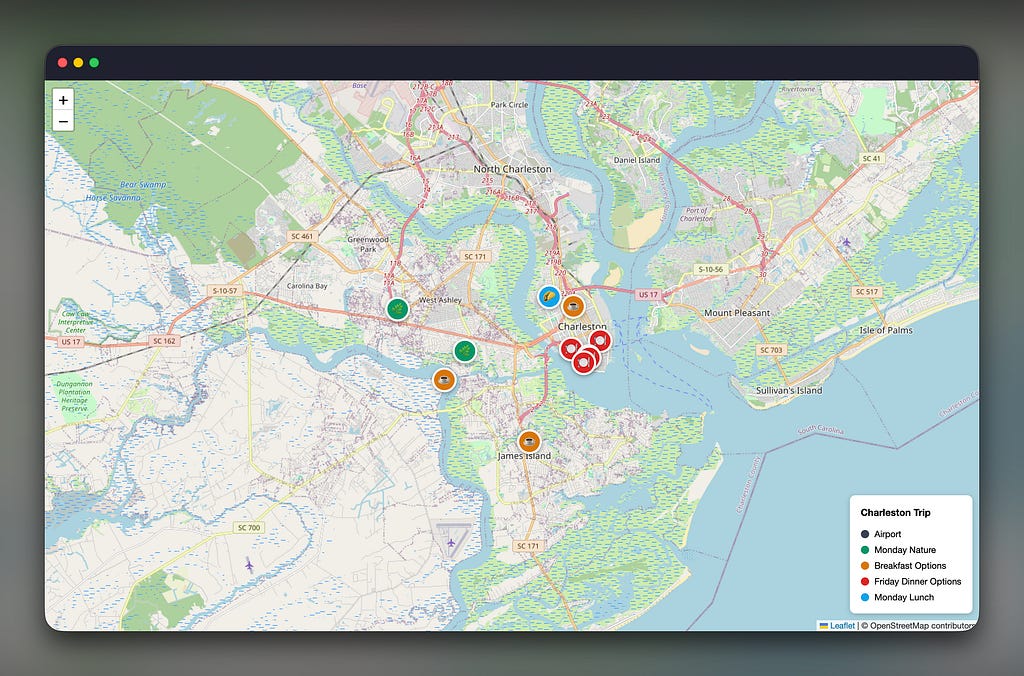
When I’m traveling, a map is the first thing I build. Proximity is how you decide what’s worth doing. A bakery five minutes from the hotel is a different decision than one twenty minutes in the wrong direction. Normally I’d finish the research, then build the map separately in Google Maps. This came out of the same conversation.
7. Making it follow you
The itinerary was done and the map was plotted. The problem is I’ve got a four-day itinerary in a workspace I’ll never open on my phone at 7am standing in a hotel lobby. What I need each morning is the day’s plan, formatted for a phone screen, in my inbox, without thinking about it.
Me: One more thing — while we’re on the trip, can you email me each morning with just that day’s schedule? I don’t want to be digging through the full itinerary on my phone.
Friday: Done. Scheduled a morning briefing for each day of the trip. I’ll pull the relevant day from the itinerary and send it at 7am. Want me to include the breakfast shortlist too, or just the locked-in items?
Me: Breakfast shortlist included, but only the top pick for each day. Keep it short.
Friday built three things inside the workspace to make that happen: an agent that reads the itinerary and writes the email, a job that sends it, and a cron schedule that fires it at 7am Eastern each morning of the trip.
What lands in my inbox Saturday morning is plain text, short enough to read while deciding whether to walk or drive to breakfast. One breakfast pick, the day’s events, any logistics that matter that morning. The Monday car dropoff time I mentioned five messages ago shows up automatically.
The conversation started with finding a venue and ended with a plan that shows up at the hotel each morning.
20 messages total. First: find this venue. Last: make it follow me to the trip. In between: a workspace, a full itinerary, four breakfast options, four dinner options, two nature spots, Monday lunch, a live map, and four morning briefings. Every constraint tracked across the whole conversation.
How this is different from tools like ChatGPT
I’ve used ChatGPT for travel research before. It’s good at generating lists. You ask “best bakeries in Charleston,” you get six options with summaries. That’s useful.
The gap shows up fast though. If you start a new conversation, it doesn’t know about the car dropoff at 2pm. It doesn’t know we don’t do seafood. It doesn’t know the venue is 25 minutes from downtown, so it can’t factor that into what makes sense for dinner. You carry all of that in your head and re-explain it every time.
A few things that are different with Friday:
It builds things, not just text. Friday generated a working interactive map as an artifact in the conversation. I can click around, with pins color-coded by category. It also built the morning email automation: an agent, a job, a cron schedule, all wired together and running. ChatGPT would tell you how to build those things, while Friday builds them.
It keeps context across the whole conversation. The car dropoff time from message 2 shaped the lunch recommendation in message 14. The venue distance from message 1 fed into the dinner suggestions six messages later. In a standard chat tool, you’d have to re-paste that context every time you started a new thread.
It shows up after you close the tab. The morning emails aren’t contingent on me opening the app. They’re scheduled and the workspace runs, as long as your computer is on. Friday sends the email at 7am whether or not I’ve thought about the trip that day. That’s the part that’s hard to get from a chat interface that only responds when you talk to it.
What made this work
The usual process is sprawl. A Notion doc for logistics, Google Maps for geography, a notes app for food research, browser tabs for everything you haven’t saved yet. The problem with those tools is that none of them talk to each other. You end up as the connective tissue. You remember the car dropoff is at 2pm when picking a lunch spot. You check whether WildFlour is open Monday.
Friday tracked all of it because it was all in one place. Nothing dropped between steps because there were no steps.
The map took one message. Every point was already known. The work was done.
What’s still open
Friday dinner and the specific bakery for each morning aren’t locked in. I’ll go through the shortlists before we leave. The itinerary is a starting point.
The workspace will be there when we’re ready to finish it.
Try this now on Friday Studio. It’s free to use and minutes to set up.
